
Pawn Endgames for Beginners by WGM Adriana Nikolova: A Recommended Course for Young Chess Players
High-Impact Chess Courses | ShareChess Recommends

If your child plays chess regularly, you've probably seen this happen.
They play a great game. They win material, exchange a few pieces and eventually reach an endgame with an extra pawn.
You think, "This should be an easy win now."
And then somehow... it's a draw.
Or worse, the game is lost.
This is something many young players experience. They may be good at solving tactics and remembering opening moves, but once most of the pieces come off the board, they aren't always sure what to do next.
That's one of the reasons I think Pawn Endgames for Beginners by WGM Adriana Nikolova is worth looking at.
The course is designed specifically to introduce players to the fundamentals of pawn endings in a structured, approachable way. It was also shortlisted for Best Endgame Course and Best Beginner Course in 2023.
For parents looking for an endgame resource for a young player, this is the kind of course that can fill an important gap in their chess training.
Why Should a Young Chess Player Study Pawn Endgames?
Endgames can sometimes get pushed down the priority list when children are learning chess.
There are openings to study. Tactics to solve. Middlegame positions to analyse. And, of course, tournaments every few weeks.
But endgames are where a lot of valuable lessons about chess begin to make sense.
A pawn ending is particularly useful because there aren't many pieces left to distract the player. The position forces them to think carefully about king activity, calculation, pawn structure and timing.
A single king move can change the result of the game.
A single tempo can decide whether a pawn queens.
And sometimes, having an extra pawn doesn't mean you can win.
For a young player, learning these ideas early can make their overall understanding of chess much stronger.
The Problem Many Young Players Have
One thing I have noticed with young tournament players is that they can often tell you what they want to do, but not always why it works.
For example:
"I'll push my pawn."
But should you push it?
Or should you improve your king first?
Should you exchange the pawns?
Should you enter a pawn race?
Can the opponent's king stop your passed pawn?
These are the decisions that make endgames difficult.
And they are exactly the kind of decisions young players need to learn to think through rather than simply guess.
What Does This Course Teach?
Pawn Endgames for Beginners focuses on the basic techniques and ideas that players need to understand when they reach pawn endings.
Among the important concepts covered are:
King Activity
In an endgame, the king changes completely.
During the opening and middlegame, children are taught to keep their king safe. In a pawn ending, the king often becomes the most important piece on the board.
Learning when to activate the king—and where to take it—is one of the first important endgame lessons.
Opposition
If your child has started studying endgames, you've probably heard the word opposition.
It can sound complicated when first introduced.
In reality, it is one of those concepts that becomes much easier once a player sees enough examples and understands what the kings are trying to achieve.
Learning opposition gives young players a practical tool they can use when calculating king-and-pawn positions.
Passed Pawns
Passed pawns can be extremely powerful in the endgame.
But simply having a passed pawn doesn't automatically mean you will win.
A player needs to understand how to create one, support it and stop the opponent from creating one of their own.
Pawn Races
This is one of the parts of pawn endings that children often find interesting.
Both sides may have pawns racing toward promotion.
Who gets there first?
Does the king have time to help?
Does promotion come with check?
Can the opponent stop the pawn?
These positions are excellent calculation exercises because the answer often depends on just one move.
Why This Can Be Useful for Tournament Players
For parents, here's perhaps the most important question:
Will studying pawn endings actually help my child in tournaments?
I believe it can—provided the player is also getting enough practical experience.
A young player doesn't need to reach a complicated theoretical endgame in every tournament for this knowledge to be useful.
The bigger benefit is learning how to evaluate and calculate simplified positions.
When a game reaches an endgame, a child who understands basic pawn-ending principles is less likely to panic or start pushing pawns randomly.
Instead, they can stop and ask:
Where should my king go?
Which pawn should I move?
Can my opponent create a passed pawn?
Is this position actually winning?
Those questions are valuable well beyond pawn endings.
What I Like About This Course
One of the biggest positives is that it doesn't try to make endgames unnecessarily intimidating.
The course is built around fundamental ideas rather than assuming that the student already understands advanced endgame theory.
That's important for young players.
A child who understands why a position is won is learning something much more valuable than simply memorising a position from a book.
The course has also been recognised by Chessable, having been shortlisted for both Best Endgame Course and Best Beginner Course in 2023.
A Good Addition to a Young Player's Training
If your child is already doing tactics, opening work and regular game analysis, where does an endgame course fit?
I wouldn't suggest making it another huge daily assignment.
Even a small amount of consistent endgame study can be useful.
For example:
2–3 sessions a week × 20–30 minutes
Work through a concept.
Try the positions.
Ask your child to explain why the winning move works.
Then look for similar situations in their own tournament games.
That last part is particularly important.
If your child learns opposition today and then encounters a king-and-pawn ending in a tournament next month, suddenly the lesson has a real connection to their own chess.
What Parents Should Look For
When choosing chess courses for children, I wouldn't judge a course simply by how advanced it sounds.
The better question is:
Will my child actually understand and use what they're learning?
For an endgame course, look for:
Clear explanations
Fundamental concepts
Positions the child can calculate
Practical examples
Opportunities to test understanding
Ideas that can be applied in real games
That's why a focused pawn-endgame course can sometimes be more useful for a young player than an enormous advanced endgame course.
ShareChess Verdict
⭐ ShareChess Rating: 4.8/5
Best for: Young chess players, beginners, junior tournament players and club-level players who want to build a proper endgame foundation.
Our take:
If your child is serious about chess, don't let endgames become something they study only after they've "finished" openings and tactics.
They never really finish those either.
Endgame knowledge should grow alongside the rest of their chess.
Pawn Endgames for Beginners is a good place to start because it focuses on a small but extremely important part of the game.
For a young tournament player, learning king activity, opposition, passed pawns and pawn races can make the difference between knowing that a position looks winning and actually knowing how to win it.
And perhaps that's the biggest reason to consider this course.
Your child doesn't just learn more endgame positions.
They learn to think differently when fewer pieces are left on the board.
⭐ ShareChess Recommends
Shortlisted for Best Endgame Course 2023
A practical introduction to pawn endings for players who want to understand—not just memorise—the basics of endgame play.
More High-Impact Chess Courses
This is the second recommendation in ShareChess's High-Impact Chess Courses series, where we look for courses that can provide genuine practical value to chess players and, particularly, young players working toward becoming stronger tournament competitors.
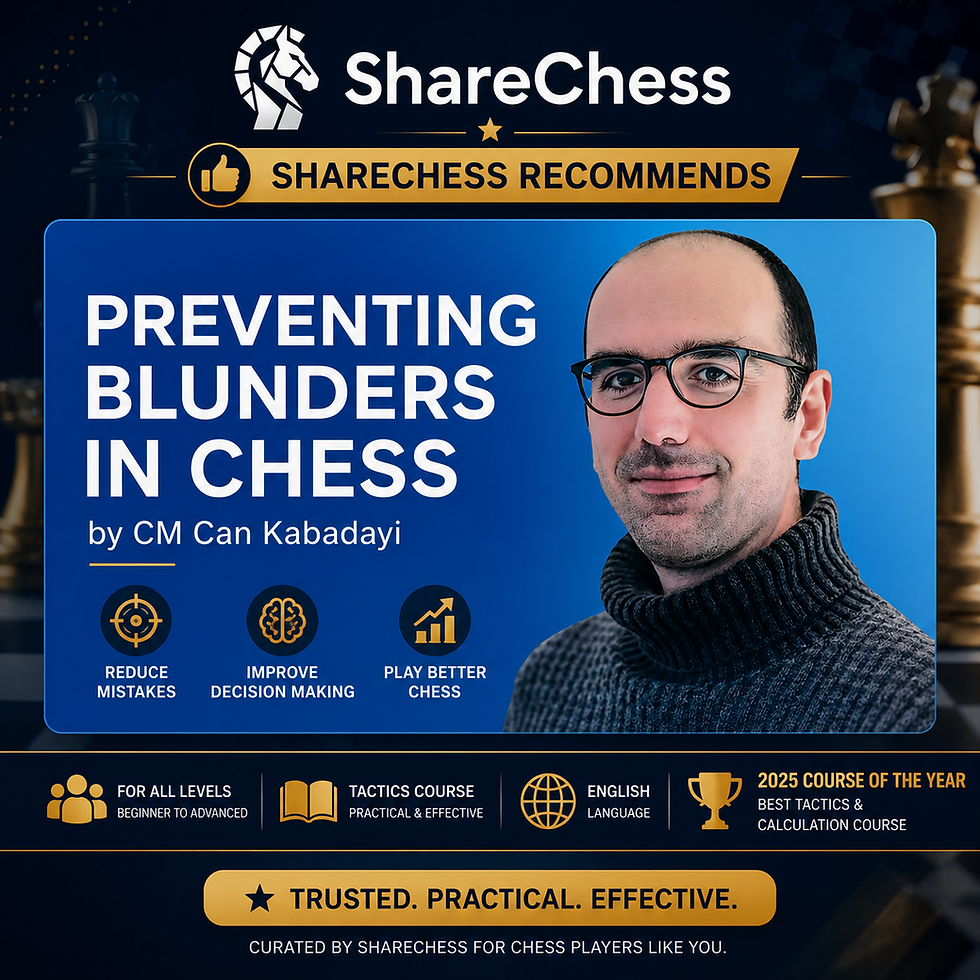
If you haven't read our first recommendation, check out:
A practical course focused on developing a better thinking process and helping players reduce the simple mistakes that often decide tournament games.
Comments